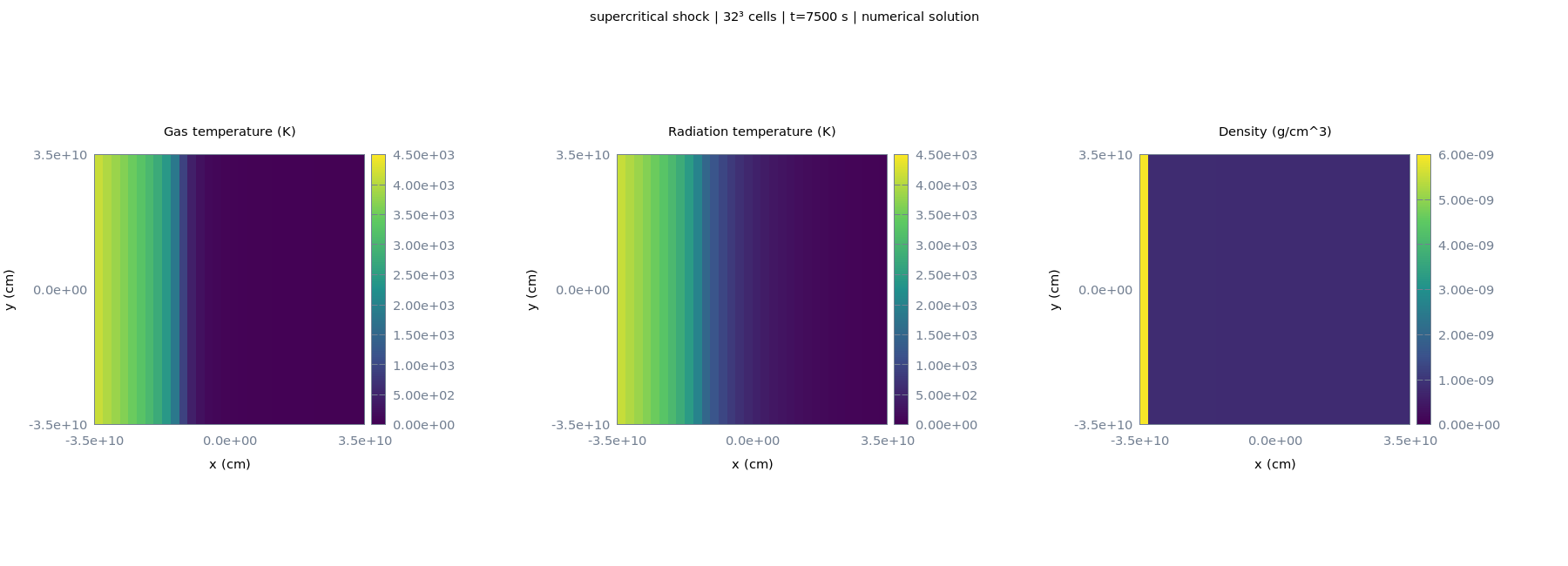
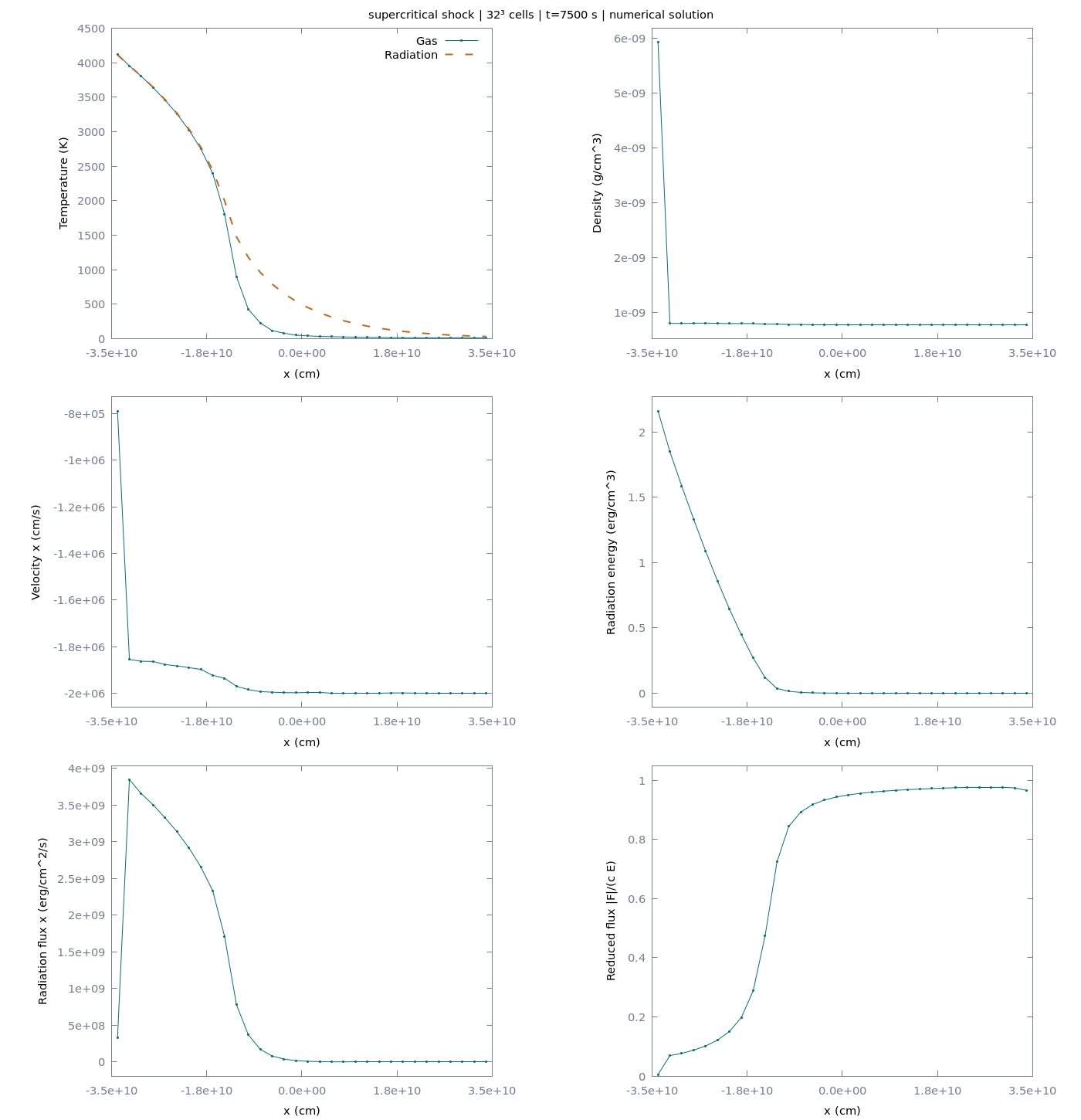
32³ cells · actual final time 7.500000e+03 s
Central cell layer at z=dx/2; ray at y=z=dx/2.
Numerical Cartesian adaptation. No independent reference profile or quantitative agreement with the original spherical benchmark is established.
M1 RK1 (Euler). Physical-light-speed radiation equations (alpha = 1); c = 29979245800 cm/s.
Recorded setup and run provenance
| Origin | Octo-TIGER application |
|---|---|
| Domain | Cube of side 7.000000e+10 cm; centered at the origin |
| Resolution | 32³ cells; finest Δx = 2.187500e+09 cm |
| Final comparison time | 7.500000e+03 s |
| Radiation model | M1 |
| Radiation integration | M1 RK1 (first order in time) |
| Flux semantics | Evolved M1 flux moment |
| Radiation backend | cpu |
| Physical light speed | 2.997925e+10 cm/s |
| Reduced-speed factor α | 1.000000e+00 |
| Radiation transport speed | 2.997925e+10 cm/s |
| Periodic boundaries | off |
| Hydrodynamics | on |
| Gravity | off |
| Implicit radiation source | on |
| Uniform grid | on |
| CFL | 0.4 |
| Timestep cap | 12.5 s |
| Output interval | 62.5 s |
{
  "background": 0.0,
  "benchmark_time": 7500.0,
  "c": 29979245800.0,
  "case": "supercritical_shock",
  "cells": 32,
  "command": [
    "/ddnB/work/dmarce1/octotiger-m1-fld-20261014/campaign/control/launch-solver",
    "/ddnB/work/dmarce1/octotiger-m1-fld-20261014/build/octotiger",
    "--config_file=/ddnB/work/dmarce1/octotiger-m1-fld-20261014/campaign/runs/l2-supercritical_shock-m1/supercritical_shock/l2/run.ini",
    "--hpx:threads=64"
  ],
  "comparison_signature": {
    "atomic_mass": "1",
    "atomic_number": "1",
    "cfl": "0.4",
    "code_to_cm": "1",
    "code_to_g": "1",
    "code_to_s": "1",
    "correct_am_hydro": "off",
    "disable_analytic": "on",
    "disable_diagnostics": "on",
    "eos": "IDEAL",
    "gravity": "off",
    "hard_dt": "12.5",
    "hydro": "on",
    "hydro_device_kernel_type": "OFF",
    "hydro_host_kernel_type": "LEGACY",
    "inflow_bc": "off",
    "monopole_device_kernel_type": "OFF",
    "multipole_device_kernel_type": "OFF",
    "n_species": "1",
    "omega": "0",
    "periodic": "off",
    "problem": "RADIATION_SUPERCRITICAL_SHOCK",
    "rad_implicit": "on",
    "radiation": "on",
    "radiation_algorithm_version": 1,
    "radiation_integrator": "euler",
    "radiation_model": "m1",
    "radiation_reduced_c_factor": "1",
    "reflect_bc": "off",
    "stop_time": "7500",
    "unigrid": "on",
    "xscale": "35000000000"
  },
  "config": {
    "atomic_mass": "1",
    "atomic_number": "1",
    "cfl": "0.4",
    "code_to_cm": "1",
    "code_to_g": "1",
    "code_to_s": "1",
    "correct_am_hydro": "off",
    "datadir": "/ddnB/work/dmarce1/octotiger-m1-fld-20261014/campaign/runs/l2-supercritical_shock-m1/supercritical_shock/l2/",
    "disable_analytic": "on",
    "disable_diagnostics": "on",
    "disable_output": "off",
    "eos": "IDEAL",
    "gravity": "off",
    "hard_dt": "12.5",
    "hydro": "on",
    "hydro_device_kernel_type": "OFF",
    "hydro_host_kernel_type": "LEGACY",
    "inflow_bc": "off",
    "max_level": "2",
    "min_level": "2",
    "monopole_device_kernel_type": "OFF",
    "multipole_device_kernel_type": "OFF",
    "n_species": "1",
    "odt": "62.5",
    "omega": "0",
    "periodic": "off",
    "problem": "RADIATION_SUPERCRITICAL_SHOCK",
    "rad_implicit": "on",
    "radiation": "on",
    "radiation_backend": "cpu",
    "radiation_integrator": "euler",
    "radiation_model": "m1",
    "radiation_reduced_c_factor": "1",
    "reflect_bc": "off",
    "stop_time": "7500",
    "unigrid": "on",
    "xscale": "35000000000"
  },
  "conservation": [
    {
      "boundary": 5.8288432116921275e+26,
      "boundary_fraction": 18.983368209737538,
      "field": "er",
      "final": 1.1172847707090453e+32,
      "final_fraction": 3638771.4383802614,
      "history_end_time": 7500.0,
      "history_scope": "full_run",
      "history_start_time": 0.0,
      "initial": 3.070500001523553e+25,
      "initial_fraction": 1.0,
      "integral_units": "erg",
      "max_abs_residual": 1.7203750576555295e+18,
      "max_normalized_error": 5.6029150197098055e-08,
      "normalization_basis": "abs(initial_energy)",
      "normalization_scale": 3.070500001523553e+25,
      "normalization_time": 0.0,
      "normalized_error": 2.581447757772057e-08,
      "normalized_residual": 2.581447757772057e-08,
      "raw_change": 1.1172844636590452e+32,
      "residual": 7.926335344172073e+17,
      "source": 1.117290292502249e+32,
      "source_fraction": 3638789.421748446,
      "zero_initial_flux_relative_tolerance": 1.4210854715202004e-14
    },
    {
      "boundary": -1.0598169498894122e+46,
      "boundary_fraction": -129435387074198.97,
      "field": "fx",
      "final": 3.094605780118399e+41,
      "final_fraction": 3779440374.429513,
      "history_end_time": 7500.0,
      "history_scope": "full_run",
      "history_start_time": 0.0,
      "initial": -8.188000004062807e+31,
      "initial_fraction": -1.0,
      "integral_units": "erg cm/s",
      "max_abs_residual": 1.2676506002282294e+30,
      "max_normalized_error": 0.015481809960909053,
      "normalization_basis": "abs(initial_component)",
      "normalization_scale": 8.188000004062807e+31,
      "normalization_time": 0.0,
      "normalized_error": 0.015481809960909053,
      "normalized_residual": -0.015481809960909053,
      "raw_change": 3.094605780937199e+41,
      "residual": -1.2676506002282294e+30,
      "source": -1.0597860038316027e+46,
      "source_fraction": -129431607633823.53,
      "zero_initial_flux_relative_tolerance": 1.4210854715202004e-14
    },
    {
      "boundary": -1.3390432255734667e+24,
      "boundary_fraction": -1.4546710364696358e-12,
      "field": "fy",
      "final": 0.0,
      "final_fraction": 0.0,
      "history_end_time": 7500.0,
      "history_scope": "full_run",
      "history_start_time": 0.0,
      "initial": 0.0,
      "initial_fraction": 0.0,
      "integral_units": "erg cm/s",
      "max_abs_residual": 2.8868172870780667e+24,
      "max_normalized_error": 3.136097039207876e-12,
      "normalization_basis": "c * abs(initial_energy)",
      "normalization_scale": 9.205127427457496e+35,
      "normalization_time": 0.0,
      "normalized_error": 1.4546710364696358e-12,
      "normalized_residual": -1.4546710364696358e-12,
      "raw_change": 0.0,
      "residual": -1.3390432255734667e+24,
      "source": 0.0,
      "source_fraction": 0.0,
      "zero_initial_flux_relative_tolerance": 1.4210854715202004e-14
    },
    {
      "boundary": 1.1959140790187454e+25,
      "boundary_fraction": 1.2991825354329322e-11,
      "field": "fz",
      "final": 0.0,
      "final_fraction": 0.0,
      "history_end_time": 7500.0,
      "history_scope": "full_run",
      "history_start_time": 0.0,
      "initial": 0.0,
      "initial_fraction": 0.0,
      "integral_units": "erg cm/s",
      "max_abs_residual": 1.366264226516231e+25,
      "max_normalized_error": 1.4842425998806626e-11,
      "normalization_basis": "c * abs(initial_energy)",
      "normalization_scale": 9.205127427457496e+35,
      "normalization_time": 0.0,
      "normalized_error": 1.2991825354329322e-11,
      "normalized_residual": 1.2991825354329322e-11,
      "raw_change": 0.0,
      "residual": 1.1959140790187454e+25,
      "source": 0.0,
      "source_fraction": 0.0,
      "zero_initial_flux_relative_tolerance": 1.4210854715202004e-14
    }
  ],
  "dx": 2187500000.0,
  "executable_sha256": "ca38f12e338eed0b7074dbb15c70c089a8d31d1c12aa87f5b044c42824721f0b",
  "inx": 8,
  "length": 70000000000.0,
  "level": 2,
  "movie_capture": {
    "hard_dt": 12.5,
    "odt": 62.5,
    "requested_snapshots": 121,
    "steps_per_output_check": 5
  },
  "origin": "Octo-TIGER application",
  "physical_c": 29979245800.0,
  "radiation_algorithm_version": 1,
  "radiation_backend": "cpu",
  "radiation_equations": "physical-c",
  "radiation_flux_semantics": "evolved_m1_flux",
  "radiation_integrator": "euler",
  "radiation_model": "m1",
  "radiation_reduced_c_factor": 1.0,
  "reference_kind": "numerical-only",
  "status": "complete",
  "time": 7500.0,
  "transport_c": 29979245800.0,
  "units": {
    "chi": "1/cm",
    "energy_density": "erg/cm^3",
    "flux": "erg/(cm^2 s)",
    "length": "cm",
    "luminosity": "erg/s",
    "mass": "g",
    "source": "erg/(cm^3 s)",
    "system": "CGS",
    "time": "s"
  },
  "validation_scope": "Numerical Cartesian adaptation. No independent reference profile or quantitative agreement with the original spherical benchmark is established."
}
Saved-state movie
Supercritical Shock · L2 · M1 RK1
121 stored states; 121 shown. Physical time: 0–7500 s. Playback: 60 s.
Zero-order hold; no solution interpolation. Playback holds each saved numerical state over its time interval and includes endpoint holds.
All 121 snapshot times
Snapshot times: 0, 62.5, 125, 187.5, 250, 312.5, 375, 437.5, 500, 562.5, 625, 687.5, 750, 812.5, 875, 937.5, 1000, 1062.5, 1125, 1187.5, 1250, 1312.5, 1375, 1437.5, 1500, 1562.5, 1625, 1687.5, 1750, 1812.5, 1875, 1937.5, 2000, 2062.5, 2125, 2187.5, 2250, 2312.5, 2375, 2437.5, 2500, 2562.5, 2625, 2687.5, 2750, 2812.5, 2875, 2937.5, 3000, 3062.5, 3125, 3187.5, 3250, 3312.5, 3375, 3437.5, 3500, 3562.5, 3625, 3687.5, 3750, 3812.5, 3875, 3937.5, 4000, 4062.5, 4125, 4187.5, 4250, 4312.5, 4375, 4437.5, 4500, 4562.5, 4625, 4687.5, 4750, 4812.5, 4875, 4937.5, 5000, 5062.5, 5125, 5187.5, 5250, 5312.5, 5375, 5437.5, 5500, 5562.5, 5625, 5687.5, 5750, 5812.5, 5875, 5937.5, 6000, 6062.5, 6125, 6187.5, 6250, 6312.5, 6375, 6437.5, 6500, 6562.5, 6625, 6687.5, 6750, 6812.5, 6875, 6937.5, 7000, 7062.5, 7125, 7187.5, 7250, 7312.5, 7375, 7437.5, 7500 s.
Arrows show the independently evolved M1 radiation flux. Arrows have equal length and show direction only.
Movies show saved numerical states; no applicable analytic reference is recorded.
Central z=0+ radiation energy slice with faint cell mesh and equal-length flux direction arrows. Arrows show the independently evolved M1 radiation flux. Gray density contours and a matching density/velocity panel. Synchronized gas and radiation temperature profiles along the central x line appear below the maps. Fixed color limits; actual stored Silo times held without solution interpolation. Movies show saved numerical states; no applicable analytic reference is recorded. The maps show the full simulation domain without cropping. The temperature profile also spans the full domain.
Download MP4 · Rendering and timing metadata · Full run report