32³ cells / level 2
Recorded setup and run provenance
| Origin | Octo-TIGER application |
|---|---|
| Domain | Cube of side 2.000000e+00 (code length); centered at the origin |
| Resolution | 32³ cells; finest Δx = 6.250000e-02 (code length) |
| Final comparison time | 6.000000e+01 (code time) |
| Radiation model | M1 |
| Radiation integration | M1 RK1 (first order in time) |
| Flux semantics | Evolved M1 flux moment |
| Radiation backend | cpu |
| Physical light speed | 1.000000e+00 (code speed) |
| Reduced-speed factor α | 1.000000e+00 |
| Radiation transport speed | 1.000000e+00 (code speed) |
| Periodic boundaries | off |
| Hydrodynamics | off |
| Gravity | off |
| Implicit radiation source | on |
| Uniform grid | on |
| CFL | 0.4 |
| Timestep cap | 0.050000000000000003 (code time) |
| Output interval | 0.5 (code time) |
{
  "background": 0.0,
  "c": 1.0,
  "case": "marshak",
  "cells": 32,
  "command": [
    "/ddnB/work/dmarce1/octotiger-m1-fld-20261014/campaign/control/launch-solver",
    "/ddnB/work/dmarce1/octotiger-m1-fld-20261014/build/octotiger",
    "--config_file=/ddnB/work/dmarce1/octotiger-m1-fld-20261014/campaign/runs/l2-marshak-m1/marshak/l2/run.ini",
    "--hpx:threads=64"
  ],
  "comparison_signature": {
    "atomic_mass": "1",
    "atomic_number": "1",
    "cfl": "0.4",
    "code_to_cm": "1",
    "code_to_g": "1",
    "code_to_s": "1",
    "correct_am_hydro": "off",
    "disable_analytic": "off",
    "disable_diagnostics": "on",
    "eos": "IDEAL",
    "gravity": "off",
    "hard_dt": "0.050000000000000003",
    "hydro": "off",
    "hydro_device_kernel_type": "OFF",
    "hydro_host_kernel_type": "LEGACY",
    "monopole_device_kernel_type": "OFF",
    "multipole_device_kernel_type": "OFF",
    "n_species": "1",
    "omega": "0",
    "periodic": "off",
    "problem": "MARSHAK",
    "rad_implicit": "on",
    "radiation": "on",
    "radiation_algorithm_version": 1,
    "radiation_integrator": "euler",
    "radiation_model": "m1",
    "radiation_reduced_c_factor": "1",
    "stop_step": "1000000",
    "stop_time": "60",
    "unigrid": "on",
    "xscale": "1"
  },
  "config": {
    "atomic_mass": "1",
    "atomic_number": "1",
    "cfl": "0.4",
    "code_to_cm": "1",
    "code_to_g": "1",
    "code_to_s": "1",
    "correct_am_hydro": "off",
    "datadir": "/ddnB/work/dmarce1/octotiger-m1-fld-20261014/campaign/runs/l2-marshak-m1/marshak/l2/",
    "disable_analytic": "off",
    "disable_diagnostics": "on",
    "disable_output": "off",
    "eos": "IDEAL",
    "gravity": "off",
    "hard_dt": "0.050000000000000003",
    "hydro": "off",
    "hydro_device_kernel_type": "OFF",
    "hydro_host_kernel_type": "LEGACY",
    "max_level": "2",
    "min_level": "2",
    "monopole_device_kernel_type": "OFF",
    "multipole_device_kernel_type": "OFF",
    "n_species": "1",
    "odt": "0.5",
    "omega": "0",
    "periodic": "off",
    "problem": "MARSHAK",
    "rad_implicit": "on",
    "radiation": "on",
    "radiation_backend": "cpu",
    "radiation_integrator": "euler",
    "radiation_model": "m1",
    "radiation_reduced_c_factor": "1",
    "stop_step": "1000000",
    "stop_time": "60",
    "unigrid": "on",
    "xscale": "1"
  },
  "conservation": [
    {
      "boundary": -13.624558525091505,
      "boundary_fraction": -0.42576745390910953,
      "field": "er",
      "final": 6.812521669367501,
      "final_fraction": 0.21289130216773441,
      "history_end_time": 60.0,
      "history_scope": "full_run",
      "history_start_time": 0.0,
      "initial": 0.0,
      "initial_fraction": 0.0,
      "integral_units": "code units",
      "max_abs_residual": 5.3290705182007514e-15,
      "max_normalized_error": 1.6653345369377348e-16,
      "normalization_basis": "bath_energy * volume",
      "normalization_scale": 32.0,
      "normalization_time": 0.0,
      "normalized_error": 0.0,
      "normalized_residual": 0.0,
      "raw_change": 6.812521669367501,
      "residual": 0.0,
      "source": -6.812036855724004,
      "source_fraction": -0.2128761517413751,
      "zero_initial_flux_relative_tolerance": 1.4210854715202004e-14
    },
    {
      "boundary": -311.43366853255327,
      "boundary_fraction": -9.73230214164229,
      "field": "fx",
      "final": 0.05268788866313581,
      "final_fraction": 0.0016464965207229941,
      "history_end_time": 60.0,
      "history_scope": "full_run",
      "history_start_time": 0.0,
      "initial": 0.0,
      "initial_fraction": 0.0,
      "integral_units": "code units",
      "max_abs_residual": 5.684341886080802e-14,
      "max_normalized_error": 1.7763568394002505e-15,
      "normalization_basis": "c * bath_energy * volume",
      "normalization_scale": 32.0,
      "normalization_time": 0.0,
      "normalized_error": 0.0,
      "normalized_residual": 0.0,
      "raw_change": 0.05268788866313581,
      "residual": 0.0,
      "source": -311.38098064389015,
      "source_fraction": -9.730655645121567,
      "zero_initial_flux_relative_tolerance": 1.4210854715202004e-14
    },
    {
      "boundary": -5.694003734421379e-21,
      "boundary_fraction": -1.779376167006681e-22,
      "field": "fy",
      "final": 0.0,
      "final_fraction": 0.0,
      "history_end_time": 60.0,
      "history_scope": "full_run",
      "history_start_time": 0.0,
      "initial": 0.0,
      "initial_fraction": 0.0,
      "integral_units": "code units",
      "max_abs_residual": 7.506356456525063e-21,
      "max_normalized_error": 2.345736392664082e-22,
      "normalization_basis": "c * bath_energy * volume",
      "normalization_scale": 32.0,
      "normalization_time": 0.0,
      "normalized_error": 1.779376167006681e-22,
      "normalized_residual": -1.779376167006681e-22,
      "raw_change": 0.0,
      "residual": -5.694003734421379e-21,
      "source": 0.0,
      "source_fraction": 0.0,
      "zero_initial_flux_relative_tolerance": 1.4210854715202004e-14
    },
    {
      "boundary": 6.310868495560712e-21,
      "boundary_fraction": 1.9721464048627224e-22,
      "field": "fz",
      "final": 0.0,
      "final_fraction": 0.0,
      "history_end_time": 60.0,
      "history_scope": "full_run",
      "history_start_time": 0.0,
      "initial": 0.0,
      "initial_fraction": 0.0,
      "integral_units": "code units",
      "max_abs_residual": 1.4002821011691316e-20,
      "max_normalized_error": 4.375881566153536e-22,
      "normalization_basis": "c * bath_energy * volume",
      "normalization_scale": 32.0,
      "normalization_time": 0.0,
      "normalized_error": 1.9721464048627224e-22,
      "normalized_residual": 1.9721464048627224e-22,
      "raw_change": 0.0,
      "residual": 6.310868495560712e-21,
      "source": 0.0,
      "source_fraction": 0.0,
      "zero_initial_flux_relative_tolerance": 1.4210854715202004e-14
    }
  ],
  "dx": 0.0625,
  "executable_sha256": "ca38f12e338eed0b7074dbb15c70c089a8d31d1c12aa87f5b044c42824721f0b",
  "inx": 8,
  "length": 2.0,
  "level": 2,
  "marshak_capacity_ratio": 1.0,
  "marshak_opacity": 100.0,
  "movie_capture": {
    "hard_dt": 0.05,
    "odt": 0.5,
    "requested_snapshots": 121,
    "steps_per_output_check": 1
  },
  "norms": {
    "er": {
      "L1": 0.1516612,
      "L2": 0.236206,
      "Linf": 0.5011435
    },
    "fx": {
      "L1": 0.00167854,
      "L2": 0.003526129,
      "Linf": 0.01695846
    },
    "fy": {
      "L1": 0.0,
      "L2": 0.0,
      "Linf": 0.0
    },
    "fz": {
      "L1": 0.0,
      "L2": 0.0,
      "Linf": 0.0
    },
    "material_egas": {
      "L1": 0.15166,
      "L2": 0.2362131,
      "Linf": 0.5011783
    }
  },
  "origin": "Octo-TIGER application",
  "physical_c": 1.0,
  "radiation_algorithm_version": 1,
  "radiation_backend": "cpu",
  "radiation_equations": "physical-c",
  "radiation_flux_semantics": "evolved_m1_flux",
  "radiation_integrator": "euler",
  "radiation_model": "m1",
  "radiation_reduced_c_factor": 1.0,
  "reference_kind": "Su-Olson nonequilibrium diffusion reference",
  "status": "complete",
  "time": 60.0,
  "transport_c": 1.0,
  "units": {
    "c": 1.0,
    "energy_density": "normalized energy density",
    "flux": "normalized flux",
    "length": "normalized length",
    "system": "dimensionless",
    "time": "normalized time"
  },
  "validation_scope": "Normalized stationary material, equal radiation/material energy capacities. Analytic diffusion comparison is not an exact solution of nonlinear M1 transport."
}
Final fields and profiles
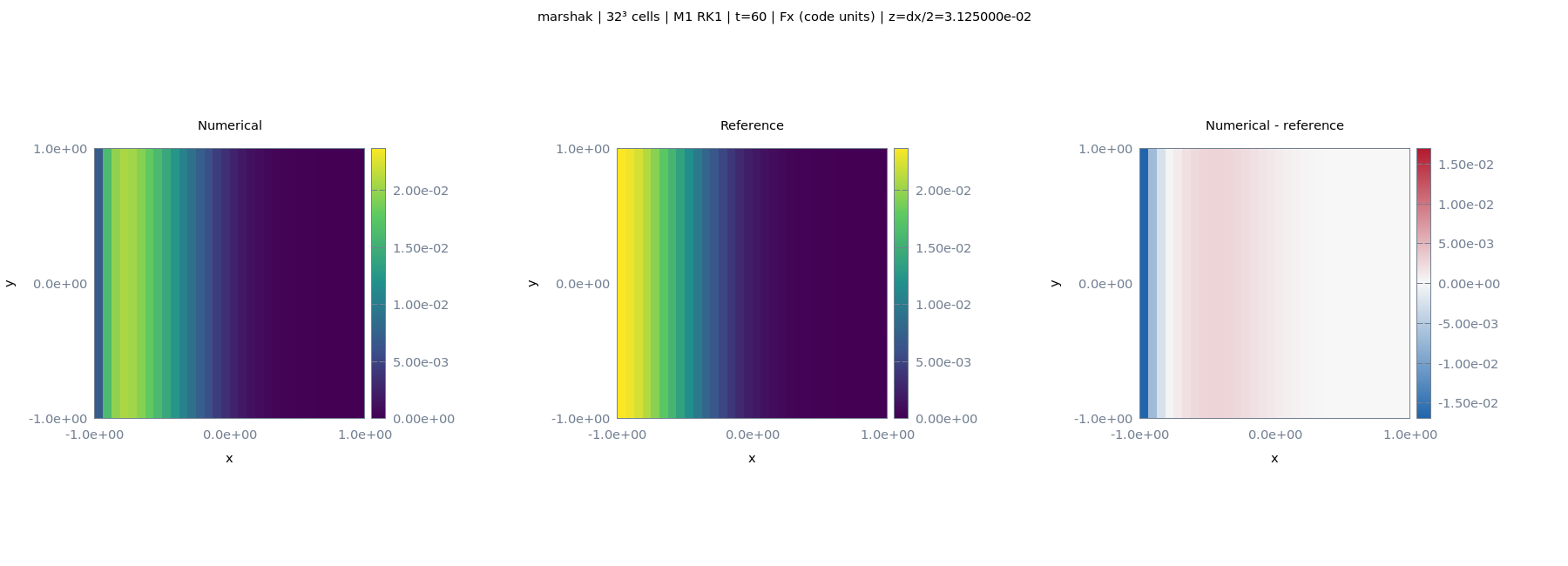
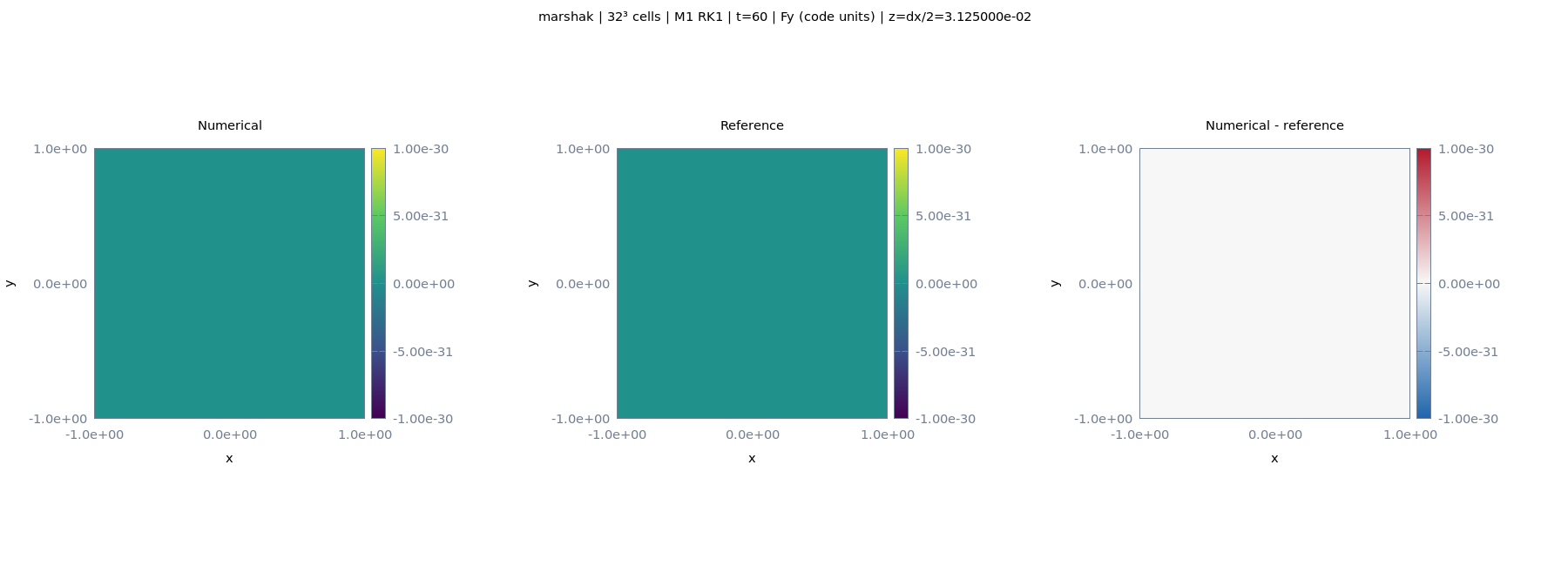
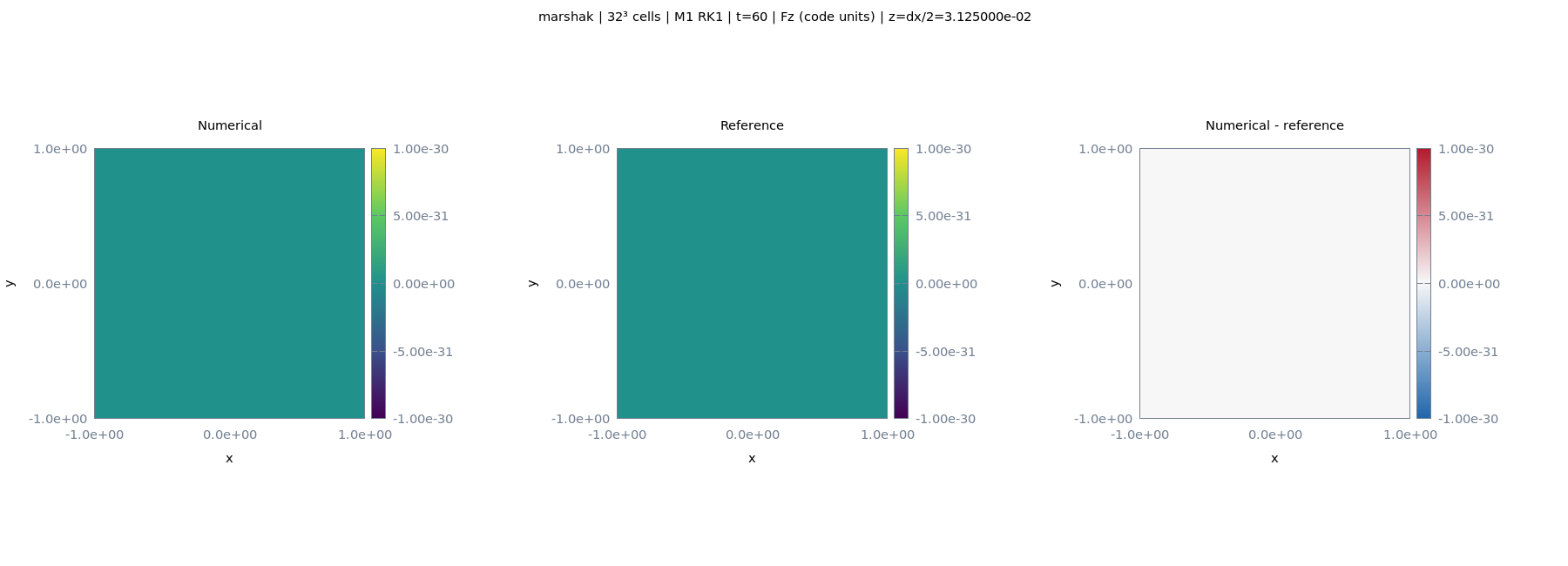
Central cell layer at z=dx/2; ray at y=z=dx/2.
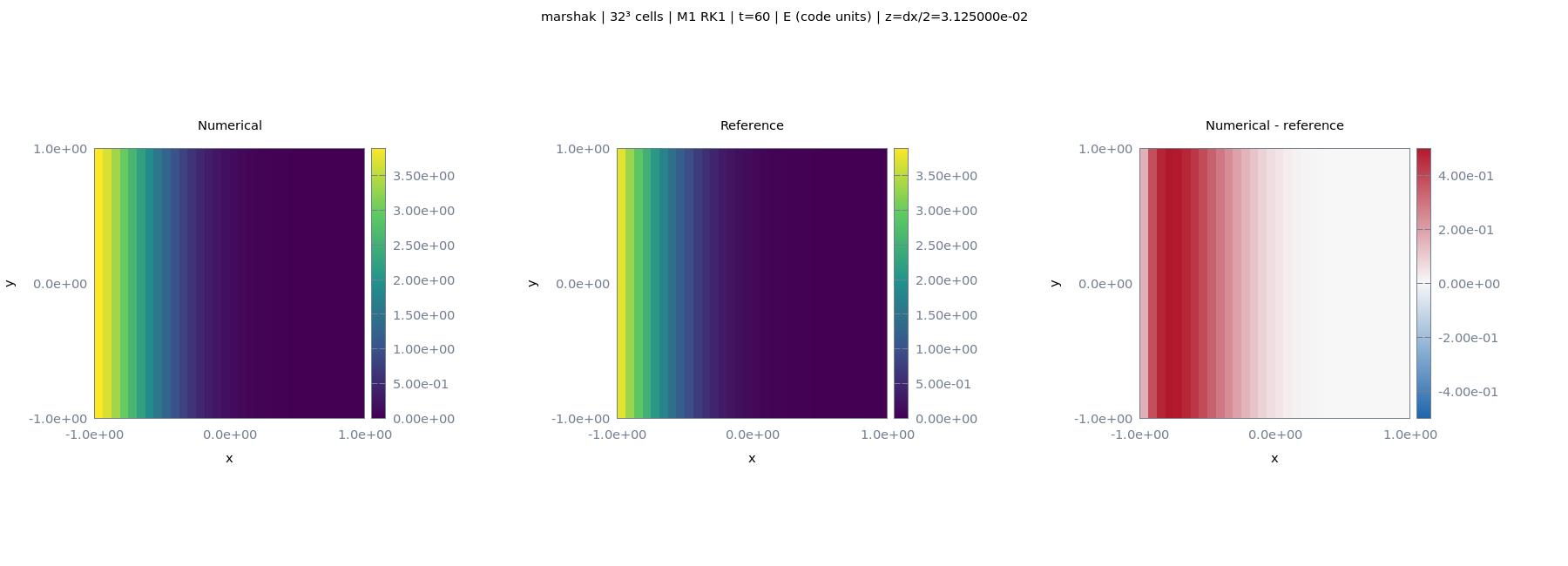
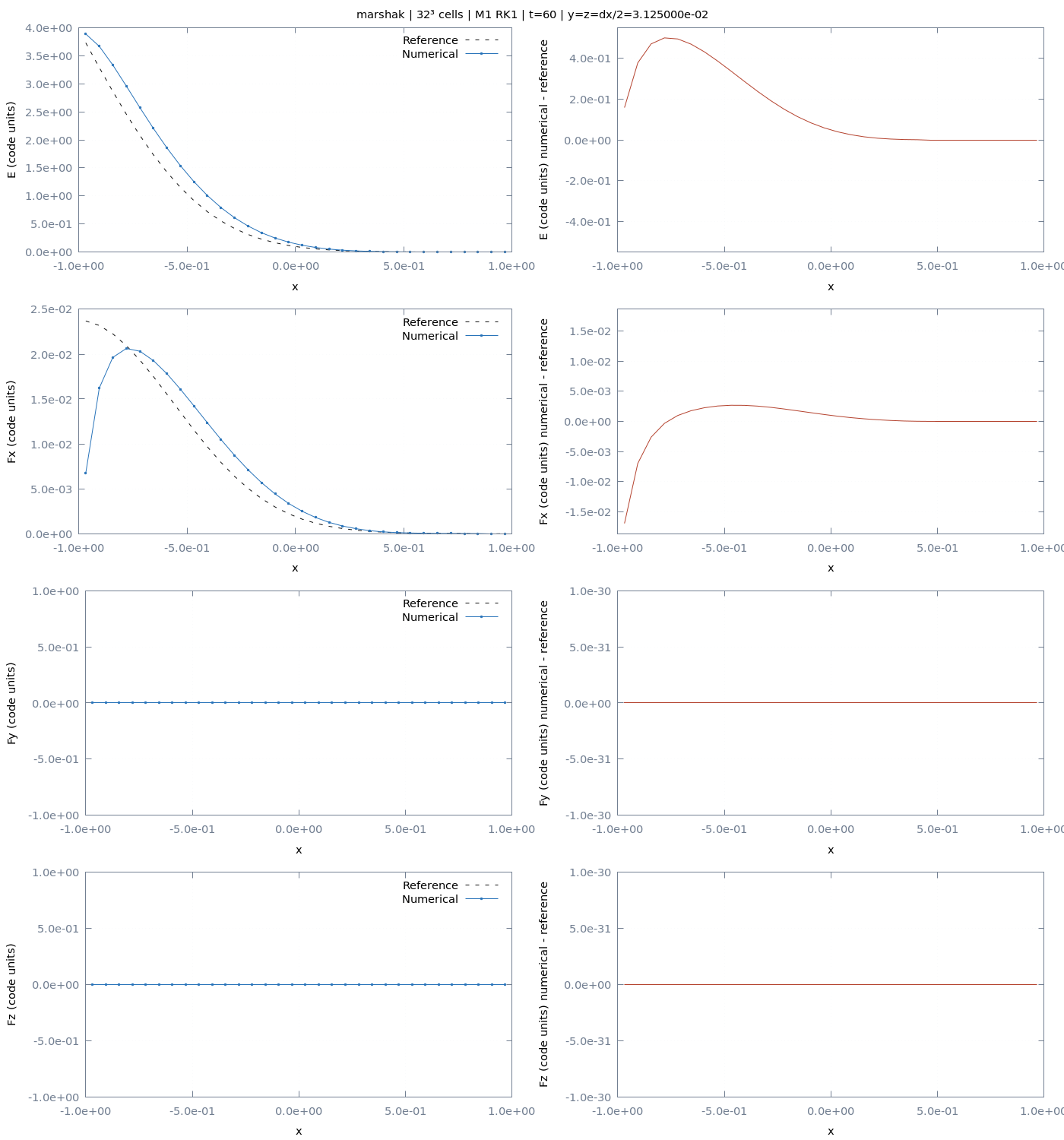
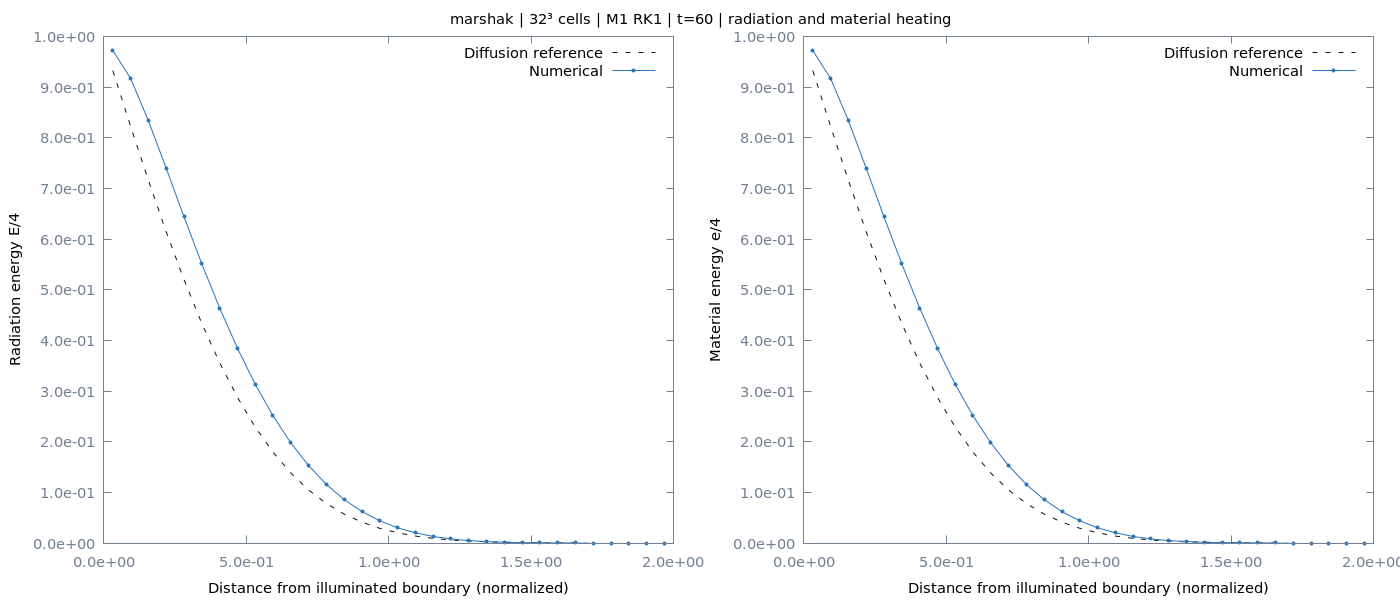
All three flux maps
Saved-state movie
Marshak · L2 · M1 RK1
121 stored states; 121 shown. Physical time: 0–60 normalized time. Playback: 60 s.
Zero-order hold; no solution interpolation. Playback holds each saved numerical state over its time interval and includes endpoint holds.
All 121 snapshot times
Snapshot times: 0, 0.505208333, 1, 1.50520833, 2.00520833, 2.5, 3, 3.5, 4, 4.5, 5.00520833, 5.50520833, 6.00520833, 6.50520833, 7.00520833, 7.50520833, 8.00520833, 8.50520833, 9.00520833, 9.50520833, 10, 10.5, 11, 11.5, 12, 12.5, 13, 13.5, 14, 14.5, 15, 15.5, 16, 16.5, 17, 17.5, 18, 18.5, 19, 19.5052083, 20.0052083, 20.5052083, 21.0052083, 21.5052083, 22.0052083, 22.5052083, 23.0052083, 23.5052083, 24.0052083, 24.5052083, 25.0052083, 25.5052083, 26.0052083, 26.5052083, 27.0052083, 27.5052083, 28.0052083, 28.5052083, 29.0052083, 29.5052083, 30.0052083, 30.5052083, 31.0052083, 31.5052083, 32.0052083, 32.5052083, 33.0052083, 33.5052083, 34.0052083, 34.5052083, 35.0052083, 35.5052083, 36.0052083, 36.5052083, 37.0052083, 37.5052083, 38.0052083, 38.5, 39, 39.5, 40, 40.5, 41, 41.5, 42, 42.5, 43, 43.5, 44, 44.5, 45, 45.5, 46, 46.5, 47, 47.5, 48, 48.5, 49, 49.5, 50, 50.5, 51, 51.5, 52, 52.5, 53, 53.5, 54, 54.5, 55, 55.5, 56, 56.5, 57, 57.5, 58, 58.5, 59, 59.5, 60 normalized time.
Arrows show the independently evolved M1 radiation flux. Arrows have equal length and show direction only.
Movies show saved numerical states; model-specific analytic comparisons are in the final-time profiles.
Central z=0+ radiation energy slice with faint cell mesh and equal-length flux direction arrows. Arrows show the independently evolved M1 radiation flux. Fixed color limits; actual stored Silo times held without solution interpolation. Movies show saved numerical states; model-specific analytic comparisons are in the final-time profiles. The maps show the full simulation domain without cropping.
Download MP4 · Rendering and timing metadata · Full run report
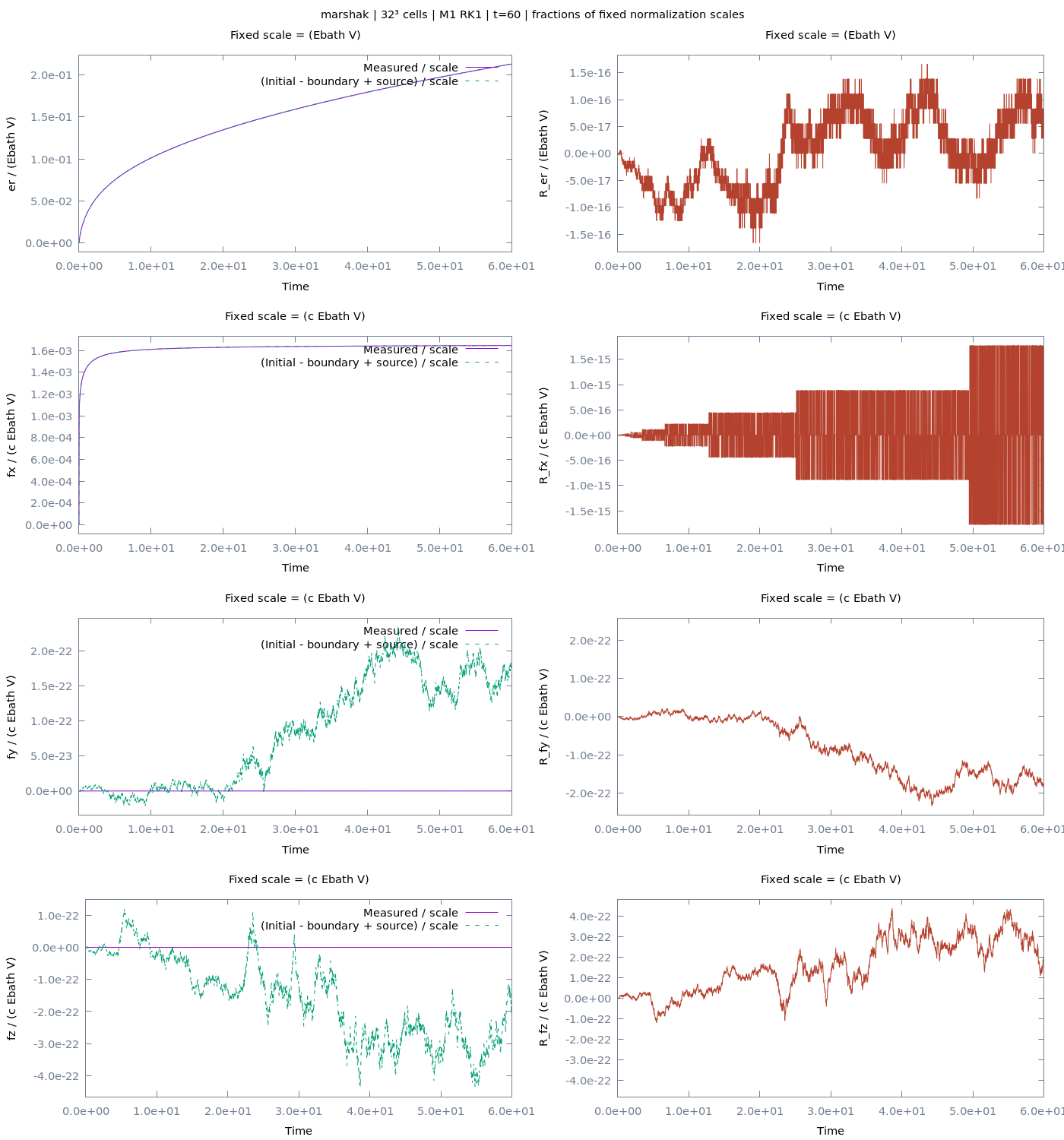
Conservation
All values below are dimensionless fractions of the fixed normalization scale at t_ref = 0.
| Field | Scale | Q(t_ref)/scale | Q(t)/scale | Boundary B/scale | Source S/scale | Residual R/scale | Maximum |R|/scale |
|---|---|---|---|---|---|---|---|
| er | Ebath V | 0.000000e+00 | 2.128913e-01 | -4.257675e-01 | -2.128762e-01 | 0.000000e+00 | 1.665335e-16 |
| fx | c Ebath V | 0.000000e+00 | 1.646497e-03 | -9.732302e+00 | -9.730656e+00 | 0.000000e+00 | 1.776357e-15 |
| fy | c Ebath V | 0.000000e+00 | 0.000000e+00 | -1.779376e-22 | 0.000000e+00 | -1.779376e-22 | 2.345736e-22 |
| fz | c Ebath V | 0.000000e+00 | 0.000000e+00 | 1.972146e-22 | 0.000000e+00 | 1.972146e-22 | 4.375882e-22 |