All problem comparisons · Campaign
Marshak: M1 RK1 and FLD backward Euler
Saved-state movies
Movies use stored numerical states, held without solution interpolation.
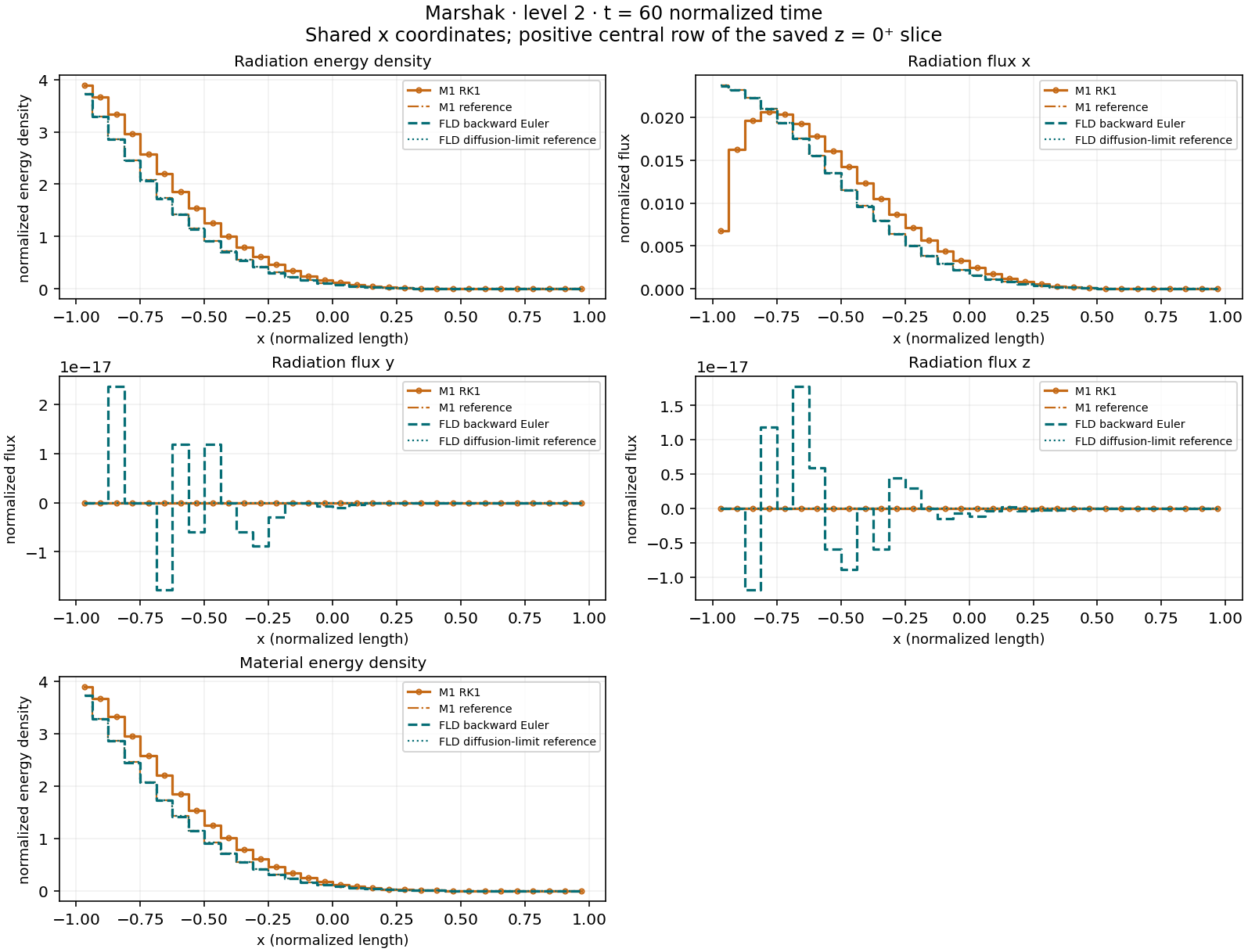
M1 reference: Su–Olson diffusion reference. The supplied Su–Olson radiation/material reference solves the linear thermal-capacity diffusion problem in normalized units. The saved parameter values define its match to the source model; diffusion and finite-speed M1 transport can differ. Reference values are evaluated at cell centers, without an additional cell-volume average.
FLD reference: Su–Olson linear diffusion analytic reference. The semi-infinite Su–Olson solution describes constant diffusion and equal linear radiation/material heat capacities. It is a diffusion-limit reference for FLD. Flux limiting, the finite-domain far boundary, cell-center sampling, and discretization can all contribute to its measured discrepancy.
M1 and FLD solve different transport closures. Both updates are first order in time. A small model discrepancy does not establish accuracy against an exact solution. M1 evolves radiation flux; FLD reconstructs diagnostic flux from its energy gradient. Flux differences are not errors in a shared radiation-momentum conservation law. FLD uses physical light speed on the CPU. Moving cases include gas transport and radiation force/work; their derived lab-frame flux includes radiation enthalpy advection.
Level 2
M1 RK1 ran on one QueenBee node, qbd121, job 1102504. Its executable, source, libraries, configuration, and imported outputs are bound to the verified completion receipt.
M1 RK1: complete results, parameters and reference discussion
FLD backward Euler ran on one QueenBee node, qbd120, job 1102539. Its executable, source, libraries, configuration, and imported outputs are bound to the verified completion receipt.
FLD backward Euler: complete results, parameters and reference discussion
matched. No other refinement level or physical time is substituted for a missing partner.
Matched profile coordinates and values (CSV)
FLD minus M1: model discrepancy on the saved slice
| Field | Units | L₁ | L₂ | L∞ |
|---|---|---|---|---|
| Radiation energy density | normalized energy density | 1.531683e-01 | 2.388598e-01 | 5.062919e-01 |
| Radiation flux x | normalized flux | 1.677128e-03 | 3.510069e-03 | 1.682666e-02 |
| Radiation flux y | normalized flux | 3.478360e-18 | 8.894457e-18 | 5.920429e-17 |
| Radiation flux z | normalized flux | 1.429447e-18 | 5.051465e-18 | 3.552451e-17 |
| Material energy density | normalized energy density | 1.531672e-01 | 2.388673e-01 | 5.063279e-01 |
M1 RK1: model-specific reference diagnostics
Su–Olson diffusion reference. The supplied Su–Olson radiation/material reference solves the linear thermal-capacity diffusion problem in normalized units. The saved parameter values define its match to the source model; diffusion and finite-speed M1 transport can differ. Reference values are evaluated at cell centers, without an additional cell-volume average.
Area-weighted reference errors on this model’s original leaf slice.
| Field | Units | L₁ | L₂ | L∞ |
|---|---|---|---|---|
| Radiation energy density | normalized energy density | 1.516612e-01 | 2.362060e-01 | 5.011435e-01 |
| Radiation flux x | normalized flux | 1.678540e-03 | 3.526129e-03 | 1.695846e-02 |
| Radiation flux y | normalized flux | 0.000000e+00 | 0.000000e+00 | 0.000000e+00 |
| Radiation flux z | normalized flux | 0.000000e+00 | 0.000000e+00 | 0.000000e+00 |
| Material energy density | normalized energy density | 1.516600e-01 | 2.362131e-01 | 5.011783e-01 |
Solver-reported full-volume reference norms
| Field | Units | L₁ | L₂ | L∞ |
|---|---|---|---|---|
| Radiation energy density | normalized energy density | 1.516612e-01 | 2.362060e-01 | 5.011435e-01 |
| Radiation flux x | normalized flux | 1.678540e-03 | 3.526129e-03 | 1.695846e-02 |
| Radiation flux y | normalized flux | 0.000000e+00 | 0.000000e+00 | 0.000000e+00 |
| Radiation flux z | normalized flux | 0.000000e+00 | 0.000000e+00 | 0.000000e+00 |
| Material energy density | normalized energy density | 1.516600e-01 | 2.362131e-01 | 5.011783e-01 |
Source slice CSV · Run metadata
FLD backward Euler: model-specific reference diagnostics
Su–Olson linear diffusion analytic reference. The semi-infinite Su–Olson solution describes constant diffusion and equal linear radiation/material heat capacities. It is a diffusion-limit reference for FLD. Flux limiting, the finite-domain far boundary, cell-center sampling, and discretization can all contribute to its measured discrepancy.
Area-weighted reference errors on this model’s original leaf slice.
| Field | Units | L₁ | L₂ | L∞ |
|---|---|---|---|---|
| Radiation energy density | normalized energy density | 1.757820e-03 | 2.736475e-03 | 6.050785e-03 |
| Radiation flux x | normalized flux | 1.458552e-05 | 2.697280e-05 | 1.318034e-04 |
| Radiation flux y | normalized flux | 3.478360e-18 | 8.894457e-18 | 5.920429e-17 |
| Radiation flux z | normalized flux | 1.429447e-18 | 5.051465e-18 | 3.552451e-17 |
| Material energy density | normalized energy density | 1.757975e-03 | 2.736841e-03 | 6.051874e-03 |
Source slice CSV · Run metadata
Momentum plots are omitted for this fixed-material problem. The prescribed medium acts as an external momentum reservoir; radiation can exchange momentum with it without evolving a compensating gas momentum.
Level 3
M1 RK1: pending.
FLD backward Euler: pending.
Momentum plots are omitted for this fixed-material problem. The prescribed medium acts as an external momentum reservoir; radiation can exchange momentum with it without evolving a compensating gas momentum.
Level 4
M1 RK1: pending.
FLD backward Euler: pending.
Momentum plots are omitted for this fixed-material problem. The prescribed medium acts as an external momentum reservoir; radiation can exchange momentum with it without evolving a compensating gas momentum.
How these comparisons are measured
All field values retain their saved units. Central profiles share x coordinates and the positive row adjacent to y = z = 0. Adaptive leaf-cell averages are prolonged as constants onto the finest common Cartesian x-y partition, without extrapolation or time interpolation. Different leaf sizes may average different z extents adjacent to the plane. These are saved finite-volume slices.
Slice L₁ is mean absolute discrepancy, L₂ is root-mean-square discrepancy, and L∞ is maximum absolute discrepancy, with area weighting. These are two-dimensional diagnostics; separately labeled solver reference norms cover the full volume. Each model is measured against its own saved reference. A diffusion-limit error includes departures of the nonlinear closure from that limit.
The saved Su–Olson reference uses cell-center point values without a cell-volume average. Reference differences for both models include sampling, closure, finite-domain, and discretization effects; Su–Olson is not an exact nonlinear M1 or flux-limited FLD solution.