Octo-TIGER / Radiation verification

Radiation test problems

M1 RK1 and FLD. Open a problem for its physical setup, comparison method, sources, and results at every completed resolution.

All requested simulations and postprocessing are complete1 completed runsl3-streaming_wave-m1

Saved-state movie

Streaming Wave · L3 · M1 RK1

121 stored states; 121 shown. Physical time: 0–0.2 s. Playback: 60 s.

Zero-order hold; no solution interpolation. Playback holds each saved numerical state over its time interval and includes endpoint holds.

All 121 snapshot times

Snapshot times: 0, 0.00166666667, 0.00333333333, 0.005, 0.007, 0.00866666667, 0.0103333333, 0.012, 0.0136666667, 0.0153333333, 0.017, 0.0183333333, 0.02, 0.0216666667, 0.0233333333, 0.025, 0.0266666667, 0.0283333333, 0.03, 0.0316666667, 0.0333333333, 0.035, 0.0366666667, 0.0383333333, 0.04, 0.0416666667, 0.0436666667, 0.0453333333, 0.047, 0.0486666667, 0.0503333333, 0.052, 0.0536666667, 0.0553333333, 0.057, 0.0586666667, 0.0603333333, 0.062, 0.0636666667, 0.0653333333, 0.067, 0.0686666667, 0.0703333333, 0.0716666667, 0.0733333333, 0.075, 0.0766666667, 0.0783333333, 0.08, 0.0816666667, 0.0833333333, 0.085, 0.0866666667, 0.0883333333, 0.09, 0.0916666667, 0.0933333333, 0.095, 0.0966666667, 0.0983333333, 0.1, 0.101666667, 0.103333333, 0.105, 0.106666667, 0.108333333, 0.11, 0.111666667, 0.113333333, 0.115, 0.116666667, 0.118333333, 0.12, 0.121666667, 0.123333333, 0.125, 0.126666667, 0.128333333, 0.13, 0.131666667, 0.133333333, 0.135, 0.136666667, 0.138333333, 0.14, 0.141666667, 0.143333333, 0.145, 0.146666667, 0.148333333, 0.15, 0.151666667, 0.153333333, 0.155333333, 0.157, 0.158666667, 0.160333333, 0.162, 0.163666667, 0.165333333, 0.167, 0.168666667, 0.170333333, 0.172, 0.173666667, 0.175333333, 0.177, 0.178666667, 0.180333333, 0.182, 0.183666667, 0.185333333, 0.187, 0.188666667, 0.190333333, 0.192, 0.193666667, 0.195333333, 0.197, 0.198666667, 0.2 s.

Arrows show the independently evolved M1 radiation flux. Arrows have equal length and show direction only.

Movies show numerical states at explicit positive opacity. Final profiles use the zero-opacity analytic solution only as a free-streaming-limit reference.

Central z=0+ radiation energy slice with faint cell mesh and equal-length flux direction arrows. Arrows show the independently evolved M1 radiation flux. Fixed color limits; actual stored Silo times held without solution interpolation. Movies show numerical states at explicit positive opacity. Final profiles use the zero-opacity analytic solution only as a free-streaming-limit reference. The maps show the full simulation domain without cropping.

Download MP4 · Rendering and timing metadata · Full run report
All campaign movies

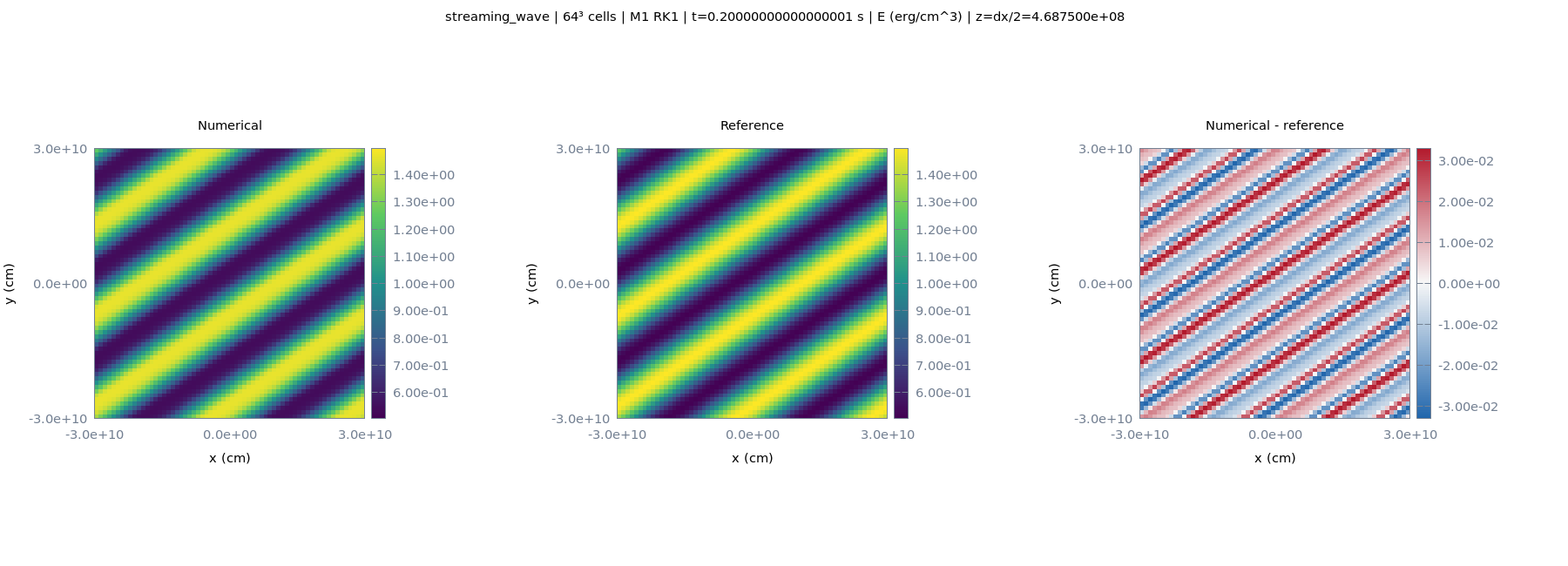
Streaming wave energy comparison
Energy comparison · 64³ cells · t = 2.000000e-01 s
Thin transport

Streaming wave

A smooth, periodic radiation wave travels at the speed of light. Its phase and amplitude test transport accuracy.

1 completed resolution

Setup & all results →
Awaiting completed results
Thin transport

Streaming front

A sharp, bright half-domain crosses a nearly dark background. Exact cell averages track both moving edges through the periodic box.

0 completed resolutions

Setup & all results →
Awaiting completed results
Telegraph equation

Gaussian pulse

A small Gaussian perturbation evolves in a fixed scattering medium. A Fourier solution of the telegraph equation supplies the reference.

0 completed resolutions

Setup & all results →
Awaiting completed results
Steady diffusion

Equilibrium sphere

A smooth spherical emitter balances outward radiation transport. An error-function solution describes its steady diffusion equilibrium.

0 completed resolutions

Setup & all results →
Awaiting completed results
Coupled radiation hydrodynamics

Subcritical radiative shock

Radiation heats gas ahead of a shock, forming a precursor whose gas temperature remains below the downstream equilibrium temperature.

0 completed resolutions

Setup & all results →
Awaiting completed results
Coupled radiation hydrodynamics

Supercritical radiative shock

A faster shock produces a stronger radiative precursor. Gas ahead of the shock approaches the downstream equilibrium temperature.

0 completed resolutions

Setup & all results →
Awaiting completed results
Coupled radiation hydrodynamics

Radiating blast wave

A spherical energy release drives a shock and radiation precursor into a radial atmosphere, evolved on a Cartesian mesh.

0 completed resolutions

Setup & all results →
Awaiting completed results
Nonequilibrium radiation diffusion

Marshak wave

Boundary illumination heats initially cold stationary material. Radiation and material energy profiles are compared with the semi-analytic Marshak diffusion solution.

0 completed resolutions

Setup & all results →
Combined plot reportAll norms CSVBatch metadata